
The Tibet–Nepal Disaster and Obligations of Cooperation: What Role for the No-Harm Rule?

Federica Passarini (Università della Tuscia)
Introduction
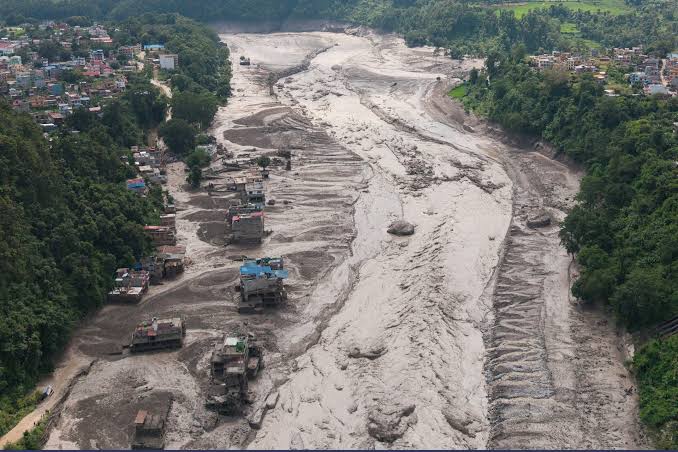
On 26 August 2026, a section of a glacier in the high Himalayas collapsed, triggering catastrophic flooding along the border between Nepal and the Tibet Autonomous Region of China. According to the Nepalese authorities, the disaster caused more than 1,300 deaths in Nepal, while almost 5,000 people remain missing. The United Nations described it as Nepal’s deadliest natural disaster since the April 2015 earthquake. On the Chinese side, the latest disaggregated official figures reported 21 deaths and more than 500 missing persons.
Civil-society responses to the Nepal–Tibet flooding have focused on identifying the State failures that may have contributed to the catastrophic impact of the natural hazard (see Telor and Gayle). Such scrutiny has become increasingly common in the aftermath of disasters triggered by natural hazards, particularly because advances in climate-attribution science have made it possible to assess the influence of climate change on particular weather events. At the same time, developments in disaster risk studies have helped to identify the underlying human factors that determine the harmful effects of natural hazards, including development choices that increase communities’ exposure and vulnerability to such hazards (see the UNDRR terminology on disaster risk reduction).
Among the various factors that may have contributed to the high number of casualties following the glacier collapse in the Himalayas, particular attention has been paid to the limited cooperation between China and Nepal in monitoring natural hazards in the region and promptly exchanging information about the risks they pose (see Telor). This lack of cooperation is particularly troubling because glacial melting and related flooding along the Nepal–Tibet border are becoming increasingly frequent. In 2020, for instance, an inventory of glacial lakes identified 47 potentially dangerous lakes in the Koshi, Gandaki and Karnali river basins.
Against this background, this blog post takes the Nepal–Tibet disaster as an opportunity to offer a preliminary appraisal of the international legal framework governing cooperation between neighboring States in addressing risks of transboundary harm arising from natural hazards. In particular, it examines whether the customary obligation to prevent transboundary harm—the no-harm rule—entails an obligation to cooperate in addressing the risk of disasters triggered by natural hazards.
An affirmative answer is not straightforward. Most international practice and legal scholarship concerning the no-harm rule has addressed risks of human origin, particularly those arising from industrial activities capable of causing environmental harm (see the ILC’s 2001 Draft Articles on Prevention of Transboundary Harm from Hazardous Activities; Gervasi, p. 76 ss.; Brunée, p. 269 ff.). Nevertheless, the growing intensity and frequency of natural hazards make it increasingly urgent to assess whether the no-harm rule also applies to risks of natural origin, as transboundary harm arising from such hazards becomes more likely.
This analysis first examines whether and to what extent the no-harm rule applies to harm related to natural hazards. It then considers some of the potential consequences of applying the resulting legal framework to the Nepal–Tibet disaster.
A terminological clarification is necessary at the outset. This post uses the expressions ‘harm related to natural hazards’ and ‘disasters related to natural hazards’ to refer to harm triggered by natural hazards. In ordinary language, such events have traditionally been described as ‘natural disasters’. More recent international practice in the field of disaster law, however, rejects this terminology. Neither the UNDRR definition of disaster nor the ILC’s 2016 Draft Articles on the Protection of Persons in the Event of Disasters classify disasters themselves according to their natural or human origin (see, in particular, the 2016 ILC Draft Articles, commentary to draft art. 3, par. 4). This reflects the understanding that there is no such thing as a wholly natural disaster: only the hazard is natural, whereas the resulting disaster arises from the interaction between that hazard and human failures in risk management.
1. The applicability of the no-harm rule to harm related to natural hazards
For the purposes of applying the no-harm rule to disasters related to natural hazards, two scenarios must be distinguished. The first concerns transboundary harm resulting from the interaction between a natural hazard and human activities carried out in the State where the hazard originates. The second concerns harm caused by the natural hazard alone, without any interaction with human activities in that State.
(a) The application of the no-harm rule to disasters resulting from the interaction between natural hazards and human activities
The application of the no-harm rule to the first scenario raises relatively few difficulties.
It is well established under customary international law that the no-harm rule applies to any activities capable of causing physical injury in the territory of another State (2001 Draft Articles on Prevention of Transboundary Harm from Hazardous Activities, art. 1 and commentary, pars. 1–2; Corfu Channel, p. 22; Trail Smelter, p. 1965; Pulp Mills, par. 101). It may therefore encompass situations in which flooding results not only from heavy rainfall but also from the collapse of a dam, as well as situations in which radioactive material is released because of the negligent operation of a nuclear facility rather than solely because an earthquake or tsunami triggers the accident. In these cases, the activities covered by the no-harm rule would be, respectively, the construction of the dam and the operation of the nuclear facility.
Applying the obligation to prevent transboundary harm in these circumstances would be consistent with the rationale underlying the rule, namely the prohibition on the abuse of rights expressed in the maxim sic utere tuo ut alienum non laedas. This rationale was clearly articulated in the Trail Smelter arbitration, in which the tribunal stated that «no State has the right to use or permit the use of its territory in such a manner as to cause injury […] in or to the territory of another State» (p. 1965). Since the rule is concerned with preventing transboundary injury caused by activities within a State’s territory, the involvement of a natural phenomenon as the immediate trigger should not, in itself, exclude its application where an activity conducted in that State contributes to the harm.
This interpretation also finds support in legal scholarship. Particularly influential in this respect is the study commissioned by the Curatorium of the Hague Academy of International Law on the international aspects of natural and industrial catastrophes, published in 2001. In that study, Leben, Romano and Gavouneli treated disasters related to natural hazards as falling within the scope of the obligation to prevent transboundary harm (Caron and Leben, pp. 71, 382–383 and 641, respectively; see also Brown Weiss, p. 145). Their position marked a significant departure from earlier scholarship. Writing in 1928, Eagleton suggested that States could incur responsibility for the transboundary effects of disasters related to natural hazards only if a specific rule to that effect were to emerge (Eagleton, p. 125). Similarly, in 1961, Reuter contemplated responsibility for flooding caused by the failure of a dam only if international law imposed a duty to ensure that engineering works were capable of withstanding all accidents (ILC Secretariat, Force Majeure and “Fortuitous Event” as Circumstances Precluding Wrongfulness, UN Doc. A/CN.4/315, par. 551).
The contrast between these earlier views and the position subsequently adopted by Gavouneli, Romano and Leben may be explained by the fact that, when Eagleton and Reuter wrote, the prevention of disasters triggered by natural hazards was largely perceived as a matter of domestic concern. By contrast, since the early 1990s, a body of soft law instruments has emerged in the field of disaster risk management, contributing to the development of an international standard of due diligence concerning risks related to natural hazards (see, among the earliest instruments, the 1994 Yokohama Strategy and Plan of Action for a Safer World).
The application of the no-harm rule to transboundary harm resulting from the interaction between natural hazards and human activities is also confirmed by the ILC’s 2001 Draft Articles on Prevention of Transboundary Harm from Hazardous Activities (2001 Draft Articles). In the commentary to art. 1, the Commission explained that an initially safe activity may subsequently fall within the scope of the Draft Articles if a natural event makes its continued operation hazardous. The example given is that of a reservoir rendered dangerous by an earthquake (commentary to art. 1, par. 15).
Where the no-harm rule applies to risks of transboundary harm arising from the interaction between natural hazards and human activities, the State of origin is under an obligation to cooperate with potentially affected States in managing the risks arising from the activity in question. This follows from the obligation to cooperate, which is a corollary of the obligation to prevent transboundary harm (see the 2001 Draft Articles, art. 4 and commentary, par. 1; Pulp Mills, par. 102; ICJ, Advisory Opinion on the Obligations of States in respect of Climate Change, par. 301). The State of origin is therefore required to assess the risk before beginning the activity, notify potentially affected States and consult them on how the risk should be addressed (Certain Activities/Construction of a Road, pars. 104 and 168; 2001 Draft Articles, arts. 7–9). Where the risk arises from the interaction between a human activity and a natural hazard, the assessment must also take into account the effects that natural hazards may have on the activity (see, for example, the Environmental Impact Assessment Directive, art. 3(1)(e) and Annex IV(5)(d)).
(b) The application of the no-harm rule to disasters resulting from natural hazards without interaction with human activities
The second scenario concerns cases in which a natural hazard originating in one State causes a disaster in the territory of another State without any contribution from human activities carried out in the former State. Applying the no-harm rule in this context is more problematic because one of the principal conditions for its application—the existence of an activity—appears to be absent.
A further distinction is nevertheless required between cases in which the transboundary harm is caused by the natural hazard alone and those in which the harm results from the combination of the hazard with conditions of vulnerability created or aggravated by State policies. State policies may increase the vulnerability of communities and the environment to harm related to natural hazards, for example by permitting settlements in hazard-prone border areas, facilitating the degradation of ecosystems that provide natural protection, or failing to adopt and enforce building standards appropriate to the hazards affecting the border area.
Arguably, such policies are not activities falling within the scope of the no-harm rule. The ILC Draft Articles point in this direction, as they apply only to activities involving a risk of significant transboundary harm through «their physical consequences» (art. 1). In explaining this requirement, the Commission referred to the stockpiling of weapons. It clarified that the relevant physical quality lies in the explosive and incendiary characteristics of the weapons rather than in their possible belligerent use (commentary to art. 1, par. 17). Similar guidance appears in the first report of Special Rapporteur Sreenivasa Rao on the prevention of transboundary damage from hazardous activities. The report explains that the ‘physical consequences’ criterion excludes transboundary harm resulting from monetary, socio-economic or comparable State policies and instead covers activities that directly produce harmful physical effects (UN Doc. A/CN.4/487, para. 86).
Accordingly, the adoption of policies that increase social and environmental vulnerability to harm related to natural hazards does not fall within the scope of the 2001 Draft Articles. This does not automatically mean, however, that such policies are excluded from the customary no-harm rule. First, the ‘physical consequences’ criterion defines the scope of the 2001 Draft Articles and should not necessarily be treated as delimiting the customary rule in precisely the same way. Second, the increasing recognition of the complex causation of disasters—as harm resulting from the interaction between hazards and conditions of exposure and vulnerability—may render the ‘physical consequences’ requirement unduly narrow and therefore inapplicable in this context. This interpretation finds some support in Article 9 of the ILC’s Draft Articles on the Protection of Persons in the Event of Disasters, which establishes a general obligation to reduce the risk of disasters. Although Article 9 is primarily concerned with measures that States must adopt at the domestic level (commentary, para. 8), disaster risk reduction also has an inter-State dimension. That inter-State dimension is explicitly recognised in the commentary to Article 7, which emphasises the importance of cooperation during the pre-disaster phase (para. 6).
In any event, even if such policies are not considered activities for the purposes of the no-harm rule, and even where the natural hazard does not interact with any human activity, States remain subject to obligations to cooperate in addressing the emergency generated by the hazard. The emergency phase begins when the risk of harm becomes imminent, but prevention remains relevant insofar as preventive measures can still mitigate that harm. The 2001 ILC Draft Articles require States to prepare for emergencies by developing contingency plans «in cooperation, where appropriate, with the State likely to be affected» (art. 16). They also require the State of origin to notify potentially affected States promptly of an emergency (art. 17). As the commentary explains, this obligation entails the establishment of early-warning systems capable of identifying an imminent weather event and the communication of the relevant information to potentially affected States without delay (commentary to arts. 16 and 17). Moreover, the commentary expressly states that emergencies may result from natural causes (commentary to art. 17, par. 3).
A duty to notify other States of emergencies resulting from natural hazards had already been recognised in the 1978 UNEP Principles of Conduct in the Field of the Environment for the Guidance of States in the Conservation and Harmonious Utilization of Natural Resources Shared by Two or More States (Principle 9). This duty also received judicial recognition in the 2017 Advisory Opinion of the Inter-American Court of Human Rights on The Environment and Human Rights (pars. 190–191 and 196). Support for an obligation to cooperate in responding to emergencies arising from natural hazards can also be found in numerous bilateral and regional treaties establishing mechanisms for cooperation in this field (for a list of relevant treaties, see ILC Secretariat, Memorandum on the Protection of Persons in the Event of Disasters, Addendum, UN Doc. A/CN.4/590/Add.2 (2008), Annex II).
Although these sources do not specify the point at which the obligation to establish contingency plans arises, it can be argued that the obligation is triggered when a natural hazard capable of posing a risk of transboundary harm is recurring in a particular area. This approach is consistent with that taken by the European Court of Human Rights in Budayeva and Others v. Russia, which concerned a violation of the right to life following a mudslide caused by heavy rainfall (Budayeva, par. 137).
2. The application of the no-harm rule to the Nepal–Tibet disaster
Once the applicability of the no-harm rule to disasters related to natural hazards has been established, its implications for the Nepal–Tibet disaster can be assessed. This assessment is complicated, however, by two factual uncertainties.
First, uncertainty persists regarding the causes of the disaster, as the available accounts are not entirely consistent. In particular, questions have arisen concerning the precise location of the glacier collapse and the extent to which infrastructure projects in Tibet may have contributed to the severity of the disaster. Activities such as tunnelling, blasting and mining may destabilise already fragile geological environments. Moreover, hydropower installations and dams concentrate workers, equipment and economic assets in narrow river corridors through which debris flows and flash floods may travel with extraordinary force (see Aryal and Panda).
Second, doubts remain as to what information the Chinese authorities possessed about the risk of such a disaster and whether they promptly shared it with the Nepalese authorities. On the one hand, it has been alleged that the Chinese Government did not share with Nepal all the information available to it concerning the risk. On the other hand, the Chinese Government maintained that monitoring natural hazards originating in that part of the Himalayas was extremely difficult and that the full extent of the risk could not have been foreseen (see Telor).
These uncertainties make it impossible to determine whether either State breached the no-harm rule—whether because activities conducted within its territory contributed to the disaster or because it failed to provide an adequate early warning. Nevertheless, the Nepal–Tibet disaster clearly demonstrated the need for the two States to take more seriously their obligation to cooperate in addressing natural hazards.
Three months before the disaster, representatives of Nepal and China met to discuss stronger cooperation in monitoring and responding to floods, extreme weather events and glacier-related hazards. The participants considered the adoption of joint risk-reduction measures, including the preparation of glacial-lake inventories and hazard maps. Ultimately, however, no agreement was reached. The Nepalese authorities complained that they had not received sufficient information from their Chinese counterparts, while the Chinese representatives cited the difficulties involved in collecting information on flood risks in remote areas of the Himalayas. Following the disaster, however, both States appeared to recognise the need to overcome these difficulties, expressing their intention to strengthen cooperation in addressing the transboundary risks posed by disasters related to natural hazards (see Sharma, Ghoshal and Chaganti Singh).
Both the failure to conclude an agreement and the States’ subsequent reactions to the disaster appear to reveal a limited awareness of their existing legal obligations in this field. Against this background, the foregoing analysis is particularly relevant: it demonstrates that cooperation in addressing the transboundary risks posed by disasters related to natural hazards is not merely a matter of State goodwill, but an obligation under customary international law.
Given the difficulties encountered by Nepal and China in reaching an agreement, the no-harm rule and its corollary obligations provide a relevant legal framework that may serve as the basis for negotiating and concluding a treaty on the monitoring of natural hazards, the exchange of information and the provision of timely warnings.
The Author


No Comment